-
1
I really want to get very good at piano, and I am ready to spend the next 10 years of my life on it. I want you to do deep research into learning methods from a neurobiological perspective that can help me do that. I want to teach myself and I am ready to put in concentrated effort to achieve harder things, but overall I want to hack my learning by using this knowledge from neurobiology. The outcome of the research should be a knowledge base in OKF (https://github.com/GoogleCloudPlatform/knowledge-catalog/blob/main/okf/SPEC.md) as well as a website hosted at https://piano.zengarden.space, with its state attached to a Google account if possible, stored in the browser or on the web. But first let's discuss, methodically, the variety of approaches to learning, the stages, how those stages vary, the possible branches of progression, and so on. As a result I would like a training app that is addictive enough. I am also thinking of buying a real physical piano like the Kawai CA401, to get the touch and feel of a really good instrument instead of my Arturia KeyLab Essential 61 mk3 MIDI keyboard. You can assume I am near zero: I understand just the very basics.
What it led to Nothing was built yet. The reply laid out approaches, stages and branches for discussion, asked four questions back, and started four research agents on motor learning, music cognition, how practice apps hold attention, and piano pedagogy.
Work it set off3 model calls · 3 tool calls · 170 k tokens · under $1 at list prices
Fable 5.2: 3 calls, 170 k tokens
More
- 4
- research agents
- ~330
- concepts in the knowledge base
- The research overturned several things the assistant had first said from memory: sleep "enhancing" a skill, micro-rests, external focus, interleaving and the 85% rule all turned out weaker or narrower than claimed. The corrections were reported and the method was built on what survived.
- The main principle that came out: measure learning cold, on the first attempt of a different day, and not by how a passage sounds at the end of a practice session.
- The knowledge base grew to about 330 concepts in OKF format, each with its sources and a rating of how strong the evidence is.
-
2
1. I want all the branches. 2. Honestly, my motivation comes and goes. I hate it when apps push me with streaks, reminders and daily goals; the moment something feels like an obligation, I drop it. My phone and YouTube also fight for my attention. Still, I feel that I want to learn. 3. I have a spare Android tablet. 4. That may make sense.
What it led to All five branches stayed in: classical, jazz, pop, improvisation and composition. The answer about motivation changed the app more than any other message in the session.
Work it set off4 agents · 264 model calls · 876 tool calls · 69.2 M tokens · about $72 at list prices
Fable 5.2: 264 calls, 69.2 M tokens
More
- No streaks, quotas, reminders or calendars anywhere in the app. Nothing accumulates while the learner is away.
- The app opens straight to live keys with no decision to make. Suggestions sit behind a handle and are worded as offers.
- The tablet became the device at the piano. Occasional check-ins with a teacher stayed optional.
-
3
I listen to a lot of podcasts lately, though I doubt that is what you are asking about. I started my "music hobby" two years ago, with varying degrees of success, and I am not rushing. I was more focused on Ableton and synthesis, without deep understanding. As a result I produced around 10 "beginner" tracks on YouTube when inspiration came, so probably not everything is so bad. It's just that I do things in bursts: a few intense weeks, then nothing for a month or two, then back again.
What it led to The starting point was redrawn: near zero at the keys, but with two years of producing tracks. Creation became a first-class track, and because practice comes in bursts, the app was designed to behave the same after seven weeks away as after one day.
Work it set off4 agents · 51 model calls · 149 tool calls · 6.1 M tokens · about $21 at list prices
Fable 5.2: 51 calls, 6.1 M tokens
More
- Free play can be kept as a sketch: phrases are detected, a groove is taken from the playing, and a loop can be cut after the fact.
- A companion layout sits beside a DAW, follows its clock and stays silent.
- After an absence nothing changes colour, nothing is moved back, and time away is never mentioned.
-
4
My tablet is a Samsung Galaxy Tab A 10.1 (T510/T515).
What it led to A slow tablet became the performance target, which fixed several technical choices early.
Work it set off18 model calls · 57 tool calls · 3.8 M tokens · about $4 at list prices
Fable 5.2: 18 calls, 3.8 M tokens
More
- Scores are engraved ahead of time by the library pipeline and shipped as SVG; the tablet never engraves.
- Budgets: 150 KB of initial script, live keys within 1.5 s of a warm start, 16 ms frames while the cursor moves.
- Tests run under a six-fold processor slowdown at 1280 by 800 as a stand-in for the device.
-
5 shortly after
I am also thinking I could try to make it work with the Arturia MIDI keyboard.
What it led to The app was planned to work on the 61-key controller from the first day, through Web MIDI, with the app making the sound.
More
- A later change of instrument keeps everything that is known and starts a settling period only for touch.
-
6
Can you scan useful sources like https://www.musictheory.net/ and collect MIDI files or sheet music that might be useful?
What it led to A collection effort began: each source was read for its licence first, then catalogued as bundle, personal use, link only or avoid.
Work it set off9 agents · 862 model calls · 1,132 tool calls · 177 M tokens · about $118 at list prices
Fable 5.2: 862 calls, 177 M tokens
-
7 shortly after
You can search broadly: hundreds of sources, using subagents.
What it led to The search widened to many agents working in parallel across teaching repertoire, exercises, jazz and pop charts, folk tunes, datasets and partimento.
More
- 642
- sources catalogued
- 50,149
- files collected
- ~1 GB
- on disk
- 642 sources catalogued: 263 to bundle, 111 for personal use, 242 to link to, 26 to avoid.
- Lapses were reported, not hidden: one collector sent a browser-like client name after being refused, then corrected itself and deleted what it had fetched; another overwrote two manifests, which were regenerated and checked.
-
8 shortly after
Maybe there is something on GitHub.
What it led to Open repositories of scores and corpora were added: typeset editions, chorale sets, tune books and chord-progression datasets.
-
9
Generate 20 innovative ideas for the application, each with a fallback (and possible to turn off in settings). Do it in a subagent.
What it led to Twenty feature ideas, each written with what happens when it cannot work and a switch to turn it off.
Work it set off1 agent · 30 model calls · 52 tool calls · 5.4 M tokens · about $10 at list prices
Fable 5.2: 30 calls, 5.4 M tokens
More
- The rule that every optional feature has a fallback and an off switch carried through to the specification, where each feature is a self-contained folder the app can run without.
-
10
Think about the core engine, sheet-music visualisation and maybe a dynamic timeline, various modes, tools, scale trainers (and maybe other kinds of trainers) and similar things I may need over the next 10 years.
What it led to The architecture of the app itself: a capture layer that records every key press, a matcher that follows the score, analysis, a transport, interchangeable views of the music, and a catalogue of trainers.
Work it set off12 model calls · 28 tool calls · 4.0 M tokens · about $3 at list prices
Fable 5.2: 12 calls, 4.0 M tokens
More
- Raw playing is the source of truth. Everything derived from it can be rebuilt years later with better analysis.
- Views ("lenses"): staff, piano roll, keyboard, chords, structure, scanned pages.
- Trainers cover technique, reading, rhythm, ear, harmony, repertoire and creation.
-
11 shortly after
If a database is needed, I am thinking of either Firebase or a backend on my Raspberry Pi 5 (with the static site on Cloudflare Pages).
What it led to The two were compared. The app was made local-first: it works with no server at all, and a server only adds sync between devices.
-
12
Let's make it slightly more generic by having users, and let's store the data in PostgreSQL. You can find out how my Raspberry Pi 5 homelab is organised by searching earlier Claude sessions for "server ssh".
What it led to The design moved from one person's tool to accounts, profiles and PostgreSQL on the home server. Notes from earlier sessions gave the conventions of that server, and the deployment was written to match them.
Work it set off20 model calls · 42 tool calls · 7.6 M tokens · about $4 at list prices
Fable 5.2: 20 calls, 7.6 M tokens
More
- One stack per app, a proxy with a rule set in front, its own tunnel, images built in CI and never on the server, backups to a separate bucket.
- A second person can use the tablet as a Guest without touching the first profile.
-
13 shortly after
Still, let's include personal-use content that is available only to o***[email protected].
What it led to Content tiers: open, copyleft, restricted and private. Restricted collections have an access list, and nothing restricted ever appears in the public site.
-
14 shortly after
Let's include Ukrainian folk songs for personal use.
What it led to A corpus of Ukrainian folk songs was collected and placed in the restricted tier, visible to the owner only.
-
15 shortly after
The backend needs to be in Go.
What it led to The server was specified in Go: the standard HTTP library, pgx for PostgreSQL, plain SQL migrations.
-
16
Now let's design the application itself: its UX/UI, style, features and catalogues. Let's "virtually play" several scenarios and improve the initial design. We need to achieve really great usability and learning efficiency, specifically for me.
What it led to Fourteen screens were designed, then three independent agents each "played" through scenarios against them and reported where the design contradicted its own principles.
Work it set off5 agents · 194 model calls · 376 tool calls · 53.0 M tokens · about $54 at list prices
Fable 5.2: 194 calls, 53.0 M tokens
More
- 14
- screens
- 3
- simulated playtests
- 36
- revision decisions
- Found by the playtests: a panel that switched by itself, a "carry on" offer at the hardest spot, running tallies of mistakes shown to the learner, cues that moved during an attempt.
- 36 decisions revised the screens and the knowledge base.
- The look: dark ground, brass accent, paper-coloured score, a blue ramp for the states New, Met, Coming and Held.
-
17 shortly after
Meanwhile, let's generate 20 more ideas.
What it led to The idea list grew to 41, each still with a fallback and an off switch.
-
18 shortly after
Maybe it makes sense to store the library in Cloudflare's bucket service, or is it not that big?
What it led to The library was sized (a few gigabytes once engraved) and a bucket was proposed for it.
-
19
I don't think I am talking about a public bucket. Is a private bucket on Cloudflare possible for free?
What it led to A correction: the proposal had assumed a public bucket for open material. The answer was yes, and the design changed to one private bucket for everything.
Work it set off3 model calls · 3 tool calls · 1.9 M tokens · under $1 at list prices
Fable 5.2: 3 calls, 1.9 M tokens
-
20
Yes, I think we can put private material there as well and use signed links.
What it led to The storage design was settled: the whole library in one private bucket, tiers as prefixes, and the server handing out signed links that last five minutes.
Work it set off4 model calls · 3 tool calls · 2.6 M tokens · under $1 at list prices
Fable 5.2: 4 calls, 2.6 M tokens
More
- A small starter pack ships inside the static site so the app is useful with no account and no network.
-
21
Is it possible to somehow find images for the songs and display them?
What it led to Options for pictures were looked at, with their licence problems.
Work it set off1 model call · 0 tool calls · 667 k tokens · under $1 at list prices
Fable 5.2: 1 call, 667 k tokens
-
22
Maybe there is some metadata service, or additional sources?
What it led to Open metadata services were named as possible sources.
-
23
I mean as logos.
What it led to The idea narrowed from cover pictures to a small mark per piece.
Work it set off8 model calls · 14 tool calls · 5.5 M tokens · about $2 at list prices
Fable 5.2: 8 calls, 5.5 M tokens
More
- Every item gets a generated mark drawn from its opening notes, so no outside picture is needed.
-
24 shortly after
OK, let's make it a feature that is off by default.
What it led to Fetched cover art became an optional feature that is off unless switched on.
-
25 shortly after
And keep the cover art small.
What it led to Covers were capped at 96 by 96 pixels.
-
26
I need to build this app end to end, without any phases, using Opus and Sonnet agents. I want you to provide specs: spec/FRONTEND.md, spec/BACKEND.md and spec/LIBRARY.md, which should be enough on their own to build it fully end to end. Later I will launch everything in parallel (not necessarily 3 agents), so you also need some kind of spec/EXECUTION.md: a graph of the things to do to complete everything fully. You will also need to use feedback loops somehow, maybe by building an emulator or simulator, so that things can be tested early. LIBRARY should suggest how to collect everything in one bucket in a properly organised manner, with metadata, potentially adding cover art or converting things. There should be a verification of the library that confirms there are no broken files. If the markdown files become too big, you can subdivide them semantically.
What it led to The specification: shared contracts first, then frontend, backend and library documents split by topic, a simulator that stands in for a person, a keyboard and weeks of time, and an execution graph.
Work it set off34 agents · 2,687 model calls · 3,175 tool calls · 962 M tokens · about $992 at list prices
Fable 5.2: 2,687 calls, 962 M tokens
More
- 146
- spec files
- 43,900
- lines of specification
- 4,180
- numbered requirements
- 619
- tasks, 2,181 dependencies
- Contracts fix what the three parts agree on: record formats, the API, the bucket layout, configuration names.
- The simulator has a virtual learner that makes mistakes and hesitates, a fake MIDI device, a virtual clock (eight weeks of practice run in seconds), and 19 required scenarios such as "back after seven weeks" and "two devices".
- Library verification loads every published item with the web app's own loader; a generation is published only with zero broken objects.
- 1 h 22 min later
-
27
Once the full specification is finished, start an unattended run of agents to build, test and iterate on everything. Bias towards Sonnet, as the specifications are very detailed and were worked through by Fable. Use Opus, Sonnet and Haiku wisely. I am going to sleep.
What it led to A model policy was written into the plan: Sonnet builds by default, Opus takes the hard or cross-cutting tasks and later repairs, Haiku runs the independent checks.
Work it set off1,063 agents · 17,383 model calls · 18,206 tool calls · 2.00 B tokens · about $750 at list prices
Sonnet 5.5: 12,591 calls, 1.34 B tokens · Opus 5.5: 3,499 calls, 599 M tokens · Fable 5.2: 40 calls, 8.5 M tokens · Haiku 5.5: 1,253 calls, 54.5 M tokens
More
- Overnight the frontend specification agents ran into the usage limit of the most capable model and all 32 stopped mid-revision. The build could not start until the specification was whole.
- 5 h 16 min later
-
28
Continue from the points where it failed.
What it led to A plan to finish the interrupted frontend work, at first with a different model.
Work it set off3 model calls · 4 tool calls · 2.5 M tokens · about $14 at list prices
Fable 5.2: 3 calls, 2.5 M tokens
-
29
Use Fable.
What it led to The plan was interrupted and redirected to the most capable model.
Work it set off2 model calls · 1 tool call · 1.7 M tokens · about $1 at list prices
Fable 5.2: 2 calls, 1.7 M tokens
-
30
For finishing the specs.
What it led to The scope of that instruction was made clear: the strongest model finishes the specification, the build stays biased to Sonnet. A 40-agent workflow audited the 78 frontend files, assembled the entry document and settled the open questions between the three specifications.
Work it set off43 agents · 3,489 model calls · 4,124 tool calls · 973 M tokens · about $582 at list prices
Fable 5.2: 3,489 calls, 973 M tokens
More
- 40
- agents
- 16M
- tokens
- 3 h 44 min
- run time
- 183 contract change requests adopted, 13 decided differently, with each decision written down.
- The limit was reached again with three agents left.
- 4 h 19 min later
-
31
The Fable limit has been reset; please continue from where you stopped.
What it led to The last three agents ran, the execution graph was generated, and the build started: first the scaffold and contracts as code, then lanes of agents side by side.
Work it set off9 model calls · 13 tool calls · 1.1 M tokens · about $4 at list prices
Fable 5.2: 9 calls, 1.1 M tokens
More
- 14
- lanes run so far
- 483
- tasks passed their check
- 6
- failed after three repairs
- Each task goes through a build agent, then an independent agent that only runs the task's verification command, then up to three repair rounds.
- The graph is split into lanes that can run at the same time; a lane holds only tasks whose unfinished dependencies are in the same lane.
- A usage limit stops a lane without marking its tasks as failed, so the run can resume where it stopped.
- 5 h 55 min later
-
33
Can you show some intermediate results?
What it led to The whole app could not be opened yet, so screenshots were taken of the parts that already render alone.
Work it set off14 model calls · 16 tool calls · 2.9 M tokens · about $4 at list prices
Fable 5.2: 14 calls, 2.9 M tokens
More
- Three scores engraved by the library pipeline, each with its generated mark.
- The piano-roll view with fingering and the cursor.
- The staff view was shown too, with the caveat that its test fixture is a hand-made schematic and it had not yet been tried on a real engraved score.
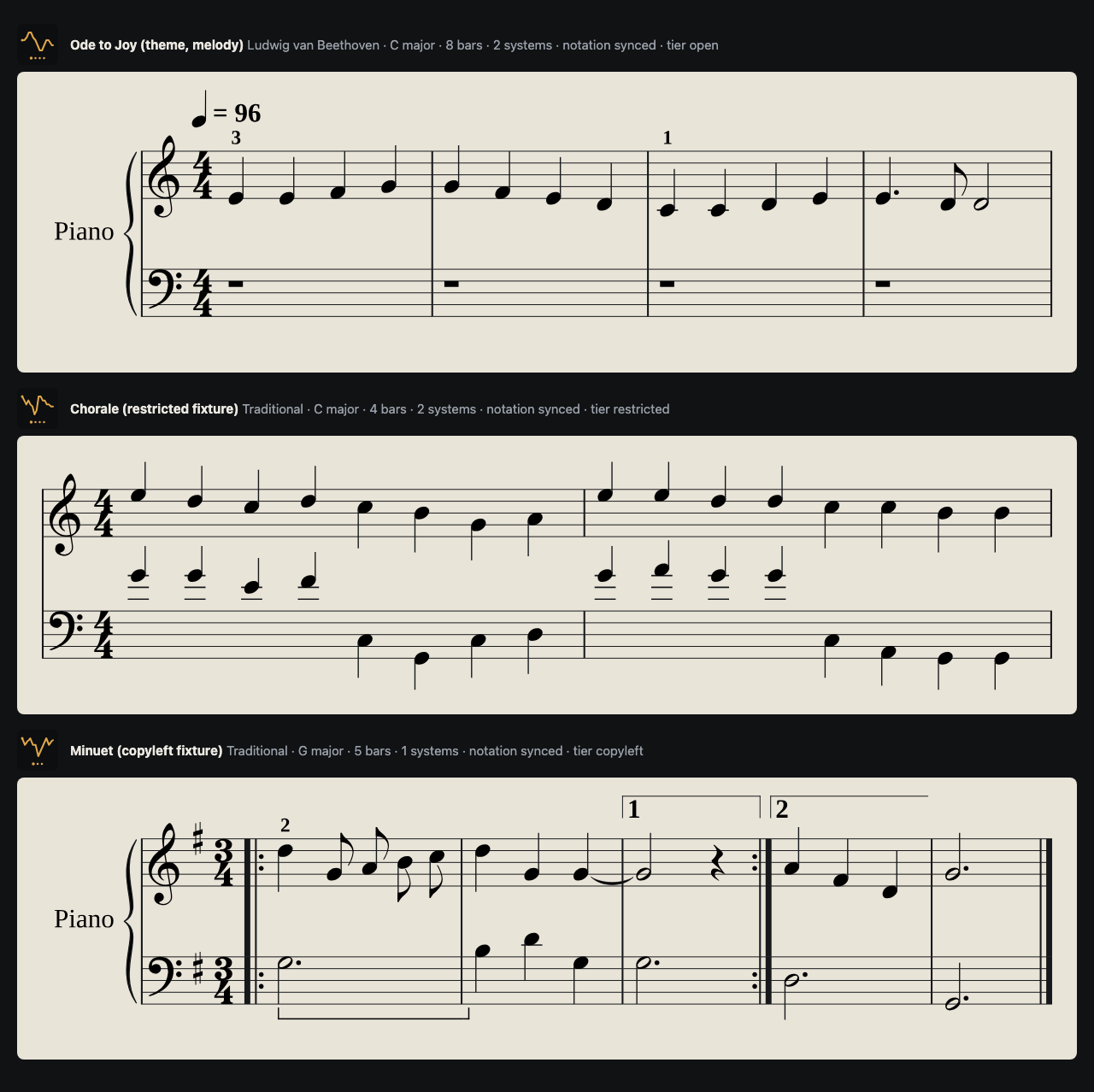
Engraved by the library pipeline from collected source files. 
The web app's piano-roll view of a minuet, cursor in bar 3. - 1 h 30 min later
- 2 h 35 min later
No prompt matches. Clear the search or pick another part.
Measured
Counted from the transcripts of the conversation and of every agent, 11 Nov, 20:48 CET, with the build still running.
- 1,180
- agents launched each with its own transcript
- 25,558
- model calls across four models
- 28,743
- tool calls commands, reads, edits
- 4.33 B
- tokens processed 95% of them re-read from cache
- 35.7 M
- tokens written by the models
- $2,660
- at API list prices an estimate, not a bill
By model
| Model | Calls | New input | Cache written | Cache read | Output | List price | Share of cost |
|---|---|---|---|---|---|---|---|
| Fable 5.2 | 7,774 | 16 k | 76.3 M | 2.22 B | 17.2 M | $1,913 | |
| Sonnet 5.5 | 12,934 | 26 k | 51.1 M | 1.30 B | 14.4 M | $402 | |
| Opus 5.5 | 3,529 | 7 k | 32.5 M | 566 M | 3.4 M | $344 | |
| Haiku 5.5 | 1,259 | 3 k | 9.5 M | 44.6 M | 626 k | $2 |
By part of the work
| Part | Agents | Model calls | Tool calls | Tokens | List price | Share of cost |
|---|---|---|---|---|---|---|
| The conversation itselfthe assistant the prompts were typed to | 318 | 453 | 105 M | $93 | ||
| Agents started one at a timeresearch, collection, playtests, design and the first drafts of the specification | 59 | 4,169 | 5,740 | 1.26 B | $1,246 | |
| Finishing the specificationone workflow, resumed once after a usage limit | 43 | 3,485 | 4,119 | 971 M | $581 | |
| Build lanesbuild, check and repair agents for each task | 1,062 | 17,213 | 18,033 | 1.97 B | $732 |
Each build lane
| Lane | Agents | Model calls | Tool calls | Tokens | List price | Ran for |
|---|---|---|---|---|---|---|
| Lane 1: scaffold and contracts as codeHaiku 5.5 22 · Opus 5.5 4 · Sonnet 5.5 76 | 11 | 102 | 108 | 7.1 M | $3 | 8 min |
| Lane 2: virtual learnerHaiku 5.5 4 · Sonnet 5.5 37 | 4 | 41 | 42 | 2.4 M | $1 | 6 min |
| Lane 3: web app foundationHaiku 5.5 305 · Sonnet 5.5 2,240 · Opus 5.5 272 | 286 | 2,817 | 2,969 | 234 M | $96 | 1 h 21 min |
| Lane 4: serverHaiku 5.5 133 · Opus 5.5 886 · Sonnet 5.5 1,412 | 118 | 2,431 | 2,511 | 302 M | $147 | 10 h 01 min |
| Lane 5: library pipelineHaiku 5.5 102 · Sonnet 5.5 1,713 · Opus 5.5 941 | 103 | 2,756 | 2,863 | 406 M | $175 | 10 h 03 min |
| Lane 6: web engine, trainers and screensHaiku 5.5 403 · Sonnet 5.5 3,160 · Opus 5.5 506 | 282 | 4,069 | 4,310 | 434 M | $145 | 3 h 11 min |
| Lane 7: web, three tasksHaiku 5.5 8 · Sonnet 5.5 43 · Opus 5.5 123 | 8 | 174 | 182 | 24.6 M | $11 | 1 h 10 min |
| Lane 8: web featuresHaiku 5.5 88 · Sonnet 5.5 1,667 · Opus 5.5 77 | 88 | 1,833 | 1,918 | 212 M | $58 | 1 h 31 min |
| Lane 9: web screensHaiku 5.5 102 · Sonnet 5.5 1,551 · Opus 5.5 94 | 102 | 1,747 | 1,837 | 201 M | $51 | 2 h 01 min |
| Lane 10: review and optional featuresHaiku 5.5 28 · Sonnet 5.5 159 | 12 | 187 | 199 | 19.0 M | $5 | 16 min |
| Lane 11: settingsHaiku 5.5 4 · Sonnet 5.5 24 | 4 | 28 | 30 | 1.6 M | $1 | 9 min |
| Lane 12: scenario runner and budgetsHaiku 5.5 12 · Sonnet 5.5 85 · Opus 5.5 91 | 12 | 188 | 198 | 23.8 M | $9 | 31 min |
| Lane 13: starter pack and publish stageHaiku 5.5 10 · Sonnet 5.5 125 | 10 | 135 | 138 | 11.4 M | $4 | 16 min |
| Lane 14: wiring the whole appHaiku 5.5 32 · Sonnet 5.5 299 · Opus 5.5 374 | 22 | 705 | 728 | 94.0 M | $28 | 2 h 50 min |
Most used tools
| Bash | 23,243 | |
|---|---|---|
| Read | 1,173 | |
| StructuredOutput | 1,102 | |
| Write | 1,055 | |
| Edit | 753 | |
| WebSearch | 463 | |
| WebFetch | 377 | |
| Monitor | 155 |
In the repository
| Commits | 582 |
|---|---|
| Files under version control | 4,605 |
| Source files | 2,471 |
| of which test files | 950 |
| Specification files | 146 |
| Knowledge base files | 348 |
| Hours from first prompt to this count | 24.9 |
How work is assigned to a prompt: an agent, and each turn of the conversation, counts for the prompt typed most recently before it started. Two exceptions follow the request and not the clock: everything the build lanes did counts for the prompt that asked for the unattended run, and the workflow that finished the specification counts for the prompt that asked for it. A prompt typed while earlier work was still running has no figures of its own.
How the price is worked out: every model call's token counts are multiplied by the public API price of its model (per million tokens: Fable 5.2 $8 in, $40 out, $0.2 cache read; Opus 5.5 $4 in, $20 out, $0.2 cache read; Sonnet 5.5 $2 in, $10 out, $0.1 cache read; Haiku 5.5 $0.1 in, $0.5 out, $0.01 cache read). Cache writes are priced at 1.25 times the input price when kept five minutes and twice when kept an hour; the Haiku cache-read price is assumed to be a tenth of its input price. The session ran under a plan with usage limits, so this is what the same work would cost through the API, not what was paid.
Where the build stood when this page was made
11 Nov, 20:50 CET. The run was still going.
| Web app | 374 of 473 tasks done | The app is wired together and starts from both builds. The scenario, browser and budget tasks were running. |
|---|---|---|
| Server | 39 of 42 | The Go API and its tests. The load test, the assembled API and the final join were still running. |
| Library pipeline | 51 of 56 | All 50,149 collected files accounted for; the last full-library run in progress. |
| Simulator and shared parts | all building blocks done | The 19 scenarios and the whole-project checks come last. |
- Nothing is deployed. The app has not been run on the tablet or with a real keyboard.
- Six tasks failed after three repair rounds and wait for the integration tasks.
- Five tasks need the owner: buckets and keys, a sign-in client, a tunnel, the site project, device measurements.